This has been an illusive goal for many Canadians. In a climate where our workforce is dwindling as retirement numbers ramp up, it's the guys that are left working who are picking up the slack. In turn, work-life balance for those left behind tips in favour of... well, work.
If you're in your youth, however, and assuming you're unmarried, it's not a bad time to focus a little bit more on career. This is the only time of your life where you can really build up a little nest egg and take advantage of the fact that you are not tied down. The demand for resources are so high that there's lots of opportunities to grow quickly in your career.
Once you've started a family though, priorities change. That's when most people start thinking more about life and less about work. But if you're a career-driven person for life, you need to find a partner who can support that.
In the end though, it seems that the balance lies in the fact that your early years are dominated by work and your later years are dominated by life. Guess that is balance... in a sense.
Showing posts with label Career. Show all posts
Showing posts with label Career. Show all posts

Passion
"Passion" has been the faddy buzz word of the decade from my perspective. Lots of people asking "what's your passion?" Still others giving compliments like "he works with passion". And on Monday, I went to this "Passion World Tour". Trying to strike a chord with a buzz word you might think? I think so. I did enjoy it though. So what's with all this "passion" stuff?
I think maybe this is an insight into the hope of the generation in its prime now - the Gen X and Y's. Perhaps passion is really a statement about doing what you really like, experiencing, working in a field you really enjoy, or just being in your own element.
For me though, I find this word somewhat frustrating. Most of us can't spend our lives living out what we enjoy, working in a field that matches our element. It's just not possible. There are jobs out there that just aren't desirable jobs. Think about all those jobs you don't want to have. Can anyone really be that passionate about those? Yet someone needs to fill those roles. And given the need to feed our families, sometimes we just have to take what's available to us. Sometimes responsibility far outweighs our passion.
So as much as everyone wants to be "passionate" about something and do something about it, I think it's still ok even if you can't. If you are doing what it takes to support your family and those you love, that's passionate enough to care for others.
I think maybe this is an insight into the hope of the generation in its prime now - the Gen X and Y's. Perhaps passion is really a statement about doing what you really like, experiencing, working in a field you really enjoy, or just being in your own element.
For me though, I find this word somewhat frustrating. Most of us can't spend our lives living out what we enjoy, working in a field that matches our element. It's just not possible. There are jobs out there that just aren't desirable jobs. Think about all those jobs you don't want to have. Can anyone really be that passionate about those? Yet someone needs to fill those roles. And given the need to feed our families, sometimes we just have to take what's available to us. Sometimes responsibility far outweighs our passion.
So as much as everyone wants to be "passionate" about something and do something about it, I think it's still ok even if you can't. If you are doing what it takes to support your family and those you love, that's passionate enough to care for others.
Preparing for Job Interviews
 If you're job-hunting right now and are not sure about what to expect on interview day, here are some tips on how you can prepare yourself. There are at least 3 things to prepare:
Objectives/Career Aspirations
Be prepared to say something about your short-term to mid-term goals and career aspirations. What kind of job are you looking for now? Why? What do you want to be in 3 to 5 years time? The short-term goals also intended to identify if the posting is a good fit for you. The mid-term to goals are intended to identify if you're stagnant in your career or still moving.
Strengths/Opportunities for Growth
Think of at least 3 strengths that you want to highlight that you think will be valuable for the job you're interviewing for. Think of how those strengths are an advantage in that particular job. Use every opportunity to stress on these strengths. Also think of 1 weakness (opportunity for growth), but do so strategically. Only pick a weakness that you're already working on to improve. Then stress about your improvement rather than the weakness. Ultimately, you want the interviewer to remember you as a candidate with a bunch of very pertinent strengths and no real weakness.
Execution
If you want to know how you look/sound as you present the above things you have prepared, stand in front of a mirror and talk about yourself. Interview yourself. Polish your execution as you deliver your messages.
Investing and Managing Wealth
 Even for young people, it is important to start learning how to invest at an early age. There are many reasons for its importance. The trend of rising costs of living means that staying alive after your working days are through is going to be expensive - more expensive than today. Furthermore, the trend towards nuclear families means that the burden of your retirement will likely not be completely born by your children. Investing and wealth management is how you bridge the gap.
Sadly, this topic isn't something that everyone gets a chance to learn. Yet, it's something that everyone needs to know. When should you invest? As long as you have an income, you should be investing and managing your wealth. Do you have a part-time or full-time job? Do you have some extra money left from that interest free student loan? Have some allowance from your parents?
How do you do it? Everyone's got a slightly different situation, but I'll recommend a framework that you can use (assuming you live in Canada)
Long Term Investments
I'm assuming here that you're still in your teens or your early twenties. You have decades of your career ahead of you but you can start investing in your retirement. You can afford to have a higher risk tolerance than your comfort level when talking about long-term investments. Why? Because over the long term, almost all investment products has an upward trend. This investment doesn't have to be an RRSP. Unless you make more than $10K in taxable income, there's really no point to put this money into RRSPs. RRSPs are only good for reducing your tax burden at the cost of locking away your money in something not very accessible. There are many investment products for this: funds, stocks, bonds, etc. Do some research and find a comfortable product for you. Be aware of the service charges. Service charges can severely hamper your investments.
Short Term Investments
This is your rainy day savings - the portion of your savings that you cannot afford to lose. You should keep this in a guaranteed income investment like a savings account or a term deposit. Make sure this money is very liquid (i.e. you can draw from it anytime you're in trouble without penalties or losing interest).
Diversifying and Dollar Cost Averaging
For your long term investments, you should look to diversify your investments. This means investing into various different industries and/or markets. You should also take advantage of dollar cost averaging. This means that when you have a larger sum of money available, break it up into smaller amounts and invest it regularly over a period of time rather than one lump sum. These strategies reduce your risk for long term investments. Don't bother doing this for your short-term guaranteed income investments.
Proportions
How much of your income should you save? That depends on your budget. Please refer to my blog on budgeting to find out how much you can save.
How much should go into short term investments and how much should go into long term? While you're still young, you can put a larger portion of your savings into long term. Say, 90%. As you age and as your need for rainy day money grows, you should lower that percentage down.
Resume-Writing Tips
A resume is an important piece of communication for you to start or progress in your career. Think of it as a personification of yourself as a prospect for a job. For the hiring manager, the resume is their first impression of you.
Given that, it's really important to put your best foot forward in your resume. Here are some tips to help you get started.
Start with content. Leave your formatting to the end.
Resume templates with a lot of fancy formatting sometimes gets distracting when you're trying to paint a picture of yourself in words. So distracting, in fact, that you may end up with a fancy looking resume that actually gives a poor reflection of you. Focus on the key messages you want to deliver first. Add the splash later on.
Use Section Headings.
In a resume, it's good to have some section headings such as Education, Experience, Skills, Objectives, etc. Not only does it make the resume easier to read, it provides a framework for you to deliver your message as well.
Strongest Sections First.
Many ask whether to put Education ahead of Experience or Skills after Education. There really isn't a fixed template. For these 3 sections in particular, rank them. Which section gives the best impression of you? Put those sections in front of the others.
Volunteer and Values
For those starting out their careers, they often do not have much to put down for Experience. In that case, it is useful to put volunteer experiences down. This can be enhanced with some prose that reflect how the experience has instilled soft skills and/or values in you.
Highlights
It's a good idea to put an Highlights section up at the top of your resume. Pull out some of the highlights of your skills, experience, accomplishments. Limit it to 3 items or less. This allows the reader to see in a glance the best qualities about you. This is the section where you answer the question "what are the 3 reasons I should hire you over the other candidates?" If you're just starting out your career, these could be community and/or academic accomplishments.
Hope this helps you get started.
Given that, it's really important to put your best foot forward in your resume. Here are some tips to help you get started.
Start with content. Leave your formatting to the end.
Resume templates with a lot of fancy formatting sometimes gets distracting when you're trying to paint a picture of yourself in words. So distracting, in fact, that you may end up with a fancy looking resume that actually gives a poor reflection of you. Focus on the key messages you want to deliver first. Add the splash later on.
Use Section Headings.
In a resume, it's good to have some section headings such as Education, Experience, Skills, Objectives, etc. Not only does it make the resume easier to read, it provides a framework for you to deliver your message as well.
Strongest Sections First.
Many ask whether to put Education ahead of Experience or Skills after Education. There really isn't a fixed template. For these 3 sections in particular, rank them. Which section gives the best impression of you? Put those sections in front of the others.
Volunteer and Values
For those starting out their careers, they often do not have much to put down for Experience. In that case, it is useful to put volunteer experiences down. This can be enhanced with some prose that reflect how the experience has instilled soft skills and/or values in you.
Highlights
It's a good idea to put an Highlights section up at the top of your resume. Pull out some of the highlights of your skills, experience, accomplishments. Limit it to 3 items or less. This allows the reader to see in a glance the best qualities about you. This is the section where you answer the question "what are the 3 reasons I should hire you over the other candidates?" If you're just starting out your career, these could be community and/or academic accomplishments.
Hope this helps you get started.
Your First Job
Going through high-school, I always admired those other kids that got part-time jobs. I never really had one during that era, though I did try a few times over the years. This became a source for discouragement for me. By the time I was in post secondary and really was thinking about the prospect of having to get a "real" job, it really scared the snot out of me. To add insult to injury, the fact that I had no work experience to put on my resume made me look like a loser on paper.
For those of you who in high-school or post-secondary and are contemplating getting a part-time job, I really commend you and encourage you to go for it. Doesn't matter if it's a paper route or flipping burgers or mopping floors. It will really help your confidence and your future prospects of starting your career. However, at this time, don't focus too much on your job. It's a stepping stone for the time being until you can build up enough education to get yourself a proper middle class job.
For those that can't seem to land that part-time job, don't fret. Look for opportunities to volunteer instead. Volunteering is a great way to build up your experience (which you can put on your resume) and also give back to your community. It's this community involvement part that's an extra icing on the resume cake.
Fortunately for me, co-op saved my bacon. So if you do find yourself in post-secondary in the same situation as I was, then do your best to get into co-op. Even if you did have a job in high school, it's still a good idea. There's no rush to finish school unless you are ready to take on the rest of your life. Landing a job is one of those important life skills.
For those of you who in high-school or post-secondary and are contemplating getting a part-time job, I really commend you and encourage you to go for it. Doesn't matter if it's a paper route or flipping burgers or mopping floors. It will really help your confidence and your future prospects of starting your career. However, at this time, don't focus too much on your job. It's a stepping stone for the time being until you can build up enough education to get yourself a proper middle class job.
For those that can't seem to land that part-time job, don't fret. Look for opportunities to volunteer instead. Volunteering is a great way to build up your experience (which you can put on your resume) and also give back to your community. It's this community involvement part that's an extra icing on the resume cake.
Fortunately for me, co-op saved my bacon. So if you do find yourself in post-secondary in the same situation as I was, then do your best to get into co-op. Even if you did have a job in high school, it's still a good idea. There's no rush to finish school unless you are ready to take on the rest of your life. Landing a job is one of those important life skills.
Gaining Direction at School
Post secondary education is tough to get through. The courses are difficult, stress levels are high, and workloads are tremendous. This blog is about surviving post secondary education while finding success and meaning. It will be a 4 part series covering:
Start off with prayer. Tap into your spiritual side to seek direction from the divine.
Then, familiarize yourself with all the programs available and the graduation requirements by reading the Academic Calendar/Almanac. Know your academic options and understand the rules for your school. You need all this background information to make an informed decision.
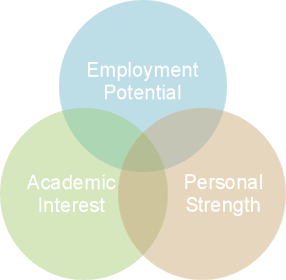 Next, set your objectives. This often starts as a debate between your vision and those of your parents. It takes some negotiation. Figure out which of the following objectives are most important to you: Employment Potential vs Academic Interest vs Personal Strenghts. Once you know your objectives, you can make a proper academic selection to match.
At the end of each academic year, it's good to look back and do a pulse check to see if you're still on track with your academic program. Also check if your academic program still fulfills your objectives.
- Gaining Direction - understanding why I'm at school
- Effective Studying - tips & tricks for studying
- Preserving My Sanity - controlling the stress
- Paying for School - maintaining good financial status
Start off with prayer. Tap into your spiritual side to seek direction from the divine.
Then, familiarize yourself with all the programs available and the graduation requirements by reading the Academic Calendar/Almanac. Know your academic options and understand the rules for your school. You need all this background information to make an informed decision.
 Next, set your objectives. This often starts as a debate between your vision and those of your parents. It takes some negotiation. Figure out which of the following objectives are most important to you: Employment Potential vs Academic Interest vs Personal Strenghts. Once you know your objectives, you can make a proper academic selection to match.
At the end of each academic year, it's good to look back and do a pulse check to see if you're still on track with your academic program. Also check if your academic program still fulfills your objectives.
Subscribe to:
Posts (Atom)

 Posts
Posts

