There are some skills that you can acquire while you're young that will save you tonnes of money as you live out your middle-class lifestyle. What are they? They're trades: electrical, plumbing, carpentry, and mechanics. If you ever get a chance to learn some basics in any or all of these things, take that opportunity.
Further down the road, you will eventually have your own place to live. It requires maintenance. You will also likely have your own vehicle. That requires maintenance too. Every hour of these handy things you can do for yourself will be an hour you won't have to pay a trades person to do. How much can you save? Ask around... trades persons for hire are expensive.
Showing posts with label Education. Show all posts
Showing posts with label Education. Show all posts

The Stress of Success
 Our parents usually encourage us to do our best or to be the best we can be. In either case, they are thinking for us out of love. Sometimes, this encouragement leads to expectation and expectation leads to pressure. Before you know it, you're forcing yourself to always achieve the results that you know your parents will be proud of, to the extent that you start to expect it of yourself. That's ok if you never miss the mark...
Quite a significant number of very gifted youth become so accustomed to achievement, success, and victory over a long period of time that when they finally don't meet their mark, it becomes a catastrophic failure. The disappointment is so vast that some have committed suicide.
So why does this happen? I'm not too sure but I think the original expectation was set by parents in most cases. Perhaps success brings so much positive reinforcement that it becomes the child's raison d'etre. Maybe there is such a thing as too much of a good thing.
So here are my tips for parents just based on observation. Although encouragement is good, I think it's equally important to assure your children that if they fail, it's not the end of the world and they can still recover. Maybe recognize effort more than results and help your child deal with setbacks rather than condemn them. After all, the people who succeed in life are those that are able to adapt to what life throws at them.
If you are a youth who feels the pressure of achievement, then maybe it's time to discuss this topic again with your parents. Be aware that failure is a learning experience. The only way to learn to cope with failure is to experience it. In future, there will come a time when you miss the mark and it's totally out of your control. Be prepared to adapt and recover from it.
Lastly, if you have just experienced the biggest disappointment of your life because you missed the mark, take a deep breath and a step back. It's time to count your blessings. Calm down. Pray. Then, think about how you can live with or recover from your setback.
Paying for School
 These days, post secondary education is extortionately expensive. With easily accessible student loans, one may think that schooling is easy to pay for. But alas, students graduate only to face an insurmountable loan. Yikes! After graduation is usually when you need money the most. That's when you can explore the world and live out your independence. Unfortunately, a big loan is going to set back your plans by many years. So here are some practical things you can do while at school to avoid this situation down the road.
Minimize Borrowing
- Student loans are a valid payment option but minimize your use
- Do your best to keep your student loans under 1/2 of your projected gross annual income of your first job (yes, start thinking about how much you can realistically make in that first job out of school)
- This is the single most valuable experience in my personal schooling
- It helps pay off school (and other luxuries)
- Provides work experience - prevents the proverbial catch-22 problem of experience/skills
- Helps develop confidence, job interview skills & resume writing skills
- Helps build professional networks
- If you take a semester break, get a job
- Apply for scholarships if you think you might qualify
- You'll never know if you'll get one unless you try
- Students need to practice spending behaviours on a shoe-string budget
- Pack your lunches as much as possible
- Get that bus pass and whatever discounts available for students
- Live at home with your parents if you can
Self Preservation while Schooling
Schooling is a busy time of life. Spending full days in lectures and classrooms is tiring. You go home exhausted yet still you push yourself to study, finish assignments, etc. One can easily lose oneself in the stressful demands and rigour of school. This blog covers some easy steps to help preserve your sanity through school:
 Personal Time
Personal Time- Set aside one evening every week just for your self
- For that one evening, don't do anything related to school
- Do something you really enjoy
- Make it regular and make it consistent
- Set aside some quiet time for reflection, meditation, and/or prayer
- Preferably daily; however, I find that consistency is more important than frequency
- If you're feeling burnt out, take a semester off and take a temporary job or go on a vacation
- Co-op/Internship semesters can help as well
Studying Effectively
Based on my own schooling I have grouped all my courses into 4 course types based on different study methods. I have compiled guidelines for each course type to help you study more effectively. This does not take away from the fact that hard work and dedication are still required.
Learning by Repetition
 These generally are math or math-dependent courses. For myself, these are the hardest credits to earn because I suck at math. There are no shortcuts through the learning curve. Here are some tips:
These are courses based on memorization, sometimes called "regurgitation" courses. For myself, they are moderately difficult credits as there are a few shortcuts available. So here are the tips:
These are courses with long essays. The credits are easy in that it is nearly impossible to fail but equally hard to excel.
Cheat Sheet Courses
These are generally science or engineering courses that allow you to bring a "cheat sheet" to your exam. Be warned, though, cheat sheet almost always means incredibly long exams. If you solely rely on your cheat sheet, you will not finish the exam by a country mile.
Learning by Repetition
These generally are math or math-dependent courses. For myself, these are the hardest credits to earn because I suck at math. There are no shortcuts through the learning curve. Here are some tips:- do the practice questions after each class.
- if you are weak in math, do more practice than the regular Joe. Ask more questions.
- do not fall behind - it's impossible to catch up in a short 13-week semester.
- avoid taking on a full course-load when taking a "Learn by Repetition" course, if possible.
- In a semester, take at most ONE "Learn by Repetition" course.
- Ask around about professors in advance. Get a reputable professor.
These are courses based on memorization, sometimes called "regurgitation" courses. For myself, they are moderately difficult credits as there are a few shortcuts available. So here are the tips:
- Attend all lectures and know what the professor deems as "important". You don't want to bother memorizing something unimportant.
- Buy a marked-up used text book. Choose the book carefully as books that are completely highlighted are useless. Study the mark-ups and don't bother reading the entire book.
These are courses with long essays. The credits are easy in that it is nearly impossible to fail but equally hard to excel.
- Essay-writing is time-consuming. Avoid taking more than 3 essay & repetition courses at the same time.
- If possible, take essay-writing courses with similar themes simultaneously. This allows you to leverage the same research but DO NOT use the same essay twice.
- Do not throw away your research notes if you still plan to take more essay courses. I found the same research comes in handy in many courses.
- Proofread your essays at least twice. If you're weak in the language, have a friend help you.
- Use the spell checker.
Cheat Sheet Courses
These are generally science or engineering courses that allow you to bring a "cheat sheet" to your exam. Be warned, though, cheat sheet almost always means incredibly long exams. If you solely rely on your cheat sheet, you will not finish the exam by a country mile.
- When making the cheat sheet, take the time to study what's on your cheat sheet so you don't have to completely rely on it.
- Memorize the topography of your cheat sheet so you do not have to hunt around.
- Do not photocopy someone else's cheat sheet. For the above 2 reasons, you'll find that the cheat sheet is useless to you.
Gaining Direction at School
Post secondary education is tough to get through. The courses are difficult, stress levels are high, and workloads are tremendous. This blog is about surviving post secondary education while finding success and meaning. It will be a 4 part series covering:
Start off with prayer. Tap into your spiritual side to seek direction from the divine.
Then, familiarize yourself with all the programs available and the graduation requirements by reading the Academic Calendar/Almanac. Know your academic options and understand the rules for your school. You need all this background information to make an informed decision.
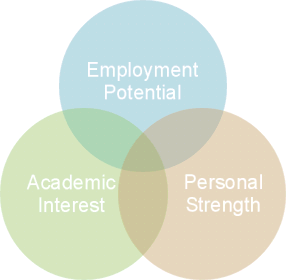 Next, set your objectives. This often starts as a debate between your vision and those of your parents. It takes some negotiation. Figure out which of the following objectives are most important to you: Employment Potential vs Academic Interest vs Personal Strenghts. Once you know your objectives, you can make a proper academic selection to match.
At the end of each academic year, it's good to look back and do a pulse check to see if you're still on track with your academic program. Also check if your academic program still fulfills your objectives.
- Gaining Direction - understanding why I'm at school
- Effective Studying - tips & tricks for studying
- Preserving My Sanity - controlling the stress
- Paying for School - maintaining good financial status
Start off with prayer. Tap into your spiritual side to seek direction from the divine.
Then, familiarize yourself with all the programs available and the graduation requirements by reading the Academic Calendar/Almanac. Know your academic options and understand the rules for your school. You need all this background information to make an informed decision.
 Next, set your objectives. This often starts as a debate between your vision and those of your parents. It takes some negotiation. Figure out which of the following objectives are most important to you: Employment Potential vs Academic Interest vs Personal Strenghts. Once you know your objectives, you can make a proper academic selection to match.
At the end of each academic year, it's good to look back and do a pulse check to see if you're still on track with your academic program. Also check if your academic program still fulfills your objectives.
Subscribe to:
Posts (Atom)

 Posts
Posts

