Over the last few months, over a dozen friends and relatives have asked me how to invest to get passive income. I've talked myself hoarse from sharing the few strategies that I use and the basics on how to execute on those strategies.
There are many investment opportunities and investment strategies out there. Not all of them are suitable for you. But if you have large savings sitting in a GIC or a Savings Account wondering if you can I make more than that, the answer is yes.
That being the case, the next question that follows is "how risky". The simple answer to that is "more". So before you delve into the details of investing, you should first examine your situation and yourself to see if you have what it takes to take on this added risk. Here are some questions to ask yourself:
Do I have money to invest that I won't use for anything else? To make a passive income, you have to have money invested the whole time. Call this seed money. Seed money isn't liquid. This means that you cannot just take it out anytime you want. You can take out your income you make off the seed money but the seed money itself should remain invested. The larger your seed money, the larger your potential to reduce your risk.
Am I temperamental? Warren Buffet, one of the world's most respected investors, once said "Once you have ordinary intelligence, what you need is the temperament to control the urges that get other people into trouble in investing." From experience, I can say that when the economy looks really bad or really good, it's easy to make brash decisions that will bite you in the end. The more you have stomach for this, the less risky you will be to yourself.
If you don't fit the bill on these exploratory questions, it's best to stand pat with the GICs and Savings Accounts.
This is the final post of this series. The next steps are to:
hide the toolbar at the top
remove the dotted lines
close the margins between the panels
Hiding the toolbar is pretty easy. Just add this to the end of your b:skin section:
#navbar { display: none; }
Removing the dotted lines isn't too difficult either. We just have to reduce the dotted border width to 0 pixels. Simply look for all instances of the word dotted. If you see:
border: 1px dotted...
Change it to:
border: 0px dotted...
And if within the same block, you see:
border-width: 1px...;
Change it to:
border-width: 0px;
Lastly, closing the margins. This is trickier as you have to do this pretty much by trial and error. Go through all the sections and tweak the margins and paddings. For the sake of brevity, I will include my entire style section here:
OK. Now my blog really looks like a canned template. Let's try to at least change the banner from the plain colour to the awesome stock photo I downloaded from Stock Exchange. So follow along as I think out loud:
First, I need to crop the photo to the dimensions I want: 1000px by 300px. So I did that with my photo editor.
Now, I need a place to host my photo. I'll use the same place where blogger puts all my photos for my blog posts - Picasa Web.
Once in Picasa, I add the photo to the e.Guidebook album. Once uploaded, I view it and right click on the photo to obtain the URL for the photo.
Once you have that, simply replace the Blog Header section:
Then we need to change the color of the title. This is stored in a variable called titleTextColor. I replaced it with a dark gray but you can choose your own color:
variable name="titleTextColor" description="Blog Title Color" type="color"
default="#fff" value="#333333"
Now that we know what you want your blog to look like, we can start working on the Blogger template. For the benefit of readers just picking up on this series, we are trying to personalize the look of the e.Guidebook blog. Here's a before/after visualization:
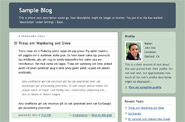
To make things easier for myself, I will modify an existing template rather than creating one from scratch. From the Layout tab, click on Pick New Template. Choose a template that matches your desired layout most closely. For me, I'm going with Minima which looks like this:
Now, the dimensions of this layout isn't quite what I visualized. I wanted a center panel that was 1000 pixels (px) wide. Minima is 740px. So let's change that.
From the Layout tab, click on Edit HTML. Yes. I am going to edit the code. Don't be scared. If anything goes wrong, I can always go back and pick Minima and join the all-look-same crowd.
Now, I'll copy all the code in the text box and paste it into Notepad so I have a working copy of the code. Need to remember to save this file frequently.
Oh good, the code looks very tidy. I like Minima.
Now, to change the width to 1000px. I change the part of the code called #outer-wrapper:
Hmm... it looks terrible. Let's widen the other 2 panels as well. I want the blog content panel to be 700px wide and the widgets panel to be 300px. Change the widths of the following sections of code:
... #sidebar-wrap { width:300px; float:$endSide; margin:15px 0 0; font-size:97%; line-height:1.5em; word-wrap: break-word; /* fix for long text breaking sidebar float in IE */ overflow: hidden; /* fix for long non-text content breaking IE sidebar float */ }
OK, now the panels look like they are the right widths, but the blog content isn't using the full width. There are 3 widths to change to fix this. I will use a blog content width of 680px so that there's a 20px margin on the right edge.
Much better. Let's now get rid of all those rounded corners. Those are actually images strategically positioned. So just look search the code for all instances of ".gif" and you can easily find all the corners. There is a vertical line going down the main section. Those are called rails and they are images too. So as you go through looking for all the GIFs, you can start removing anything that looks like corners and rails. Here's what I found:
#main-wrap1 { width:700px; float:$startSide; background:$mainBgColor url("http://www1.blogblog.com/rounders/corners_main_bot.gif") no-repeat $startSide bottom; margin:15px 0 0; padding:0 0 10px; color:$mainTextColor; font-size:97%; line-height:1.5em; word-wrap: break-word; /* fix for long text breaking sidebar float in IE */ overflow: hidden; /* fix for long non-text content breaking IE sidebar float */ }
Tonnes of blogs look the same. At time of writing, even this blog suffers from the "all-look-same" problem that comes with choosing from a small set of templates. I want to personalize the look of my blog and I'd love to take you along for the journey so you can do it too.
Recently, I've been experimenting with several different blog engines for my church's use. Along the way, I noticed that Blogger (or Blogspot), is now offering a very flexible way to customize said look & feel.
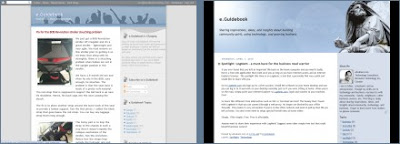
So from a visual perspective, here's what our blog looks like now (left) and my vision of how I want it to look like (right):
Therein lies the first step to customizing. Have a vision for how you would like your blog to look like. Design a layout you like respecting the fact that you still must have an area for blog posts and an area for widgets. Feel free to draw inspiration from other sites. Take a peek inside my thought process:
The blog area is way too narrow - I'd like to widen it. I don't want to use the full width of the page because I like the look of "side curtains". So maybe I could expand the content panel from 765 pixels to 1000 pixels and give most of that room to the blog posts.
My wife likes blue. A litte bit of a cold colour but tranquil. I think I will use different shades of blue for my site. And I'll use black for the side curtains - makes the page "pop" more.
I'd like to have a big banner photo at the top of the page. If only I had some photography skills like Lloyd at Night & Day or Laura Hana, I could take my own photo. Oooh! found a nice free stock photo at Stock Exchange. And it's mainly blue which goes well with my colour scheme.
Hmm, I think a 2 column layout like the way I have it now is ok. I still want all the posts to be on the left and all the widgets on the right.
Right, now let me mock this up on Corel Photo-Paint (or CorelDraw, or Adobe Illustrator, or Adobe Photoshop, or whatever design tools you prefer). I grew up on Photo-Paint so I'm sticking with what's familiar.
Oh yes, I'd like to get rid of that navigation bar/tool bar, if possible.
So go ahead and try it. If you like, post your designs somewhere (flickr, picasa, etc..) and share it with us.
We just got a BOB Revolution stroller off craigslist and it's a great stroller - lightweight and very agile. We read reviews on this stroller prior to getting it so we knew that along with its strenghts, there is a slouching problem when babies are sat in the upright position in this stroller.
We have a 6-month old son and when he sits in the BOB, sure enough, he slouches. The problem is that the seat back is made of a pretty soft material. The red strap that is supposed to support the mid back is up near his shoulders. Hence, his back sags into the seat causing the slouch.
The fix is to place another strap around the lower back of the seat to provide a lumbar support. See the first photo. I added the black strap that goes below the red strap. You can buy any luggage strap that's long enough.
The tricky part is to loop the strap to the chassis in such a way that it doesn't impede the collapse mechanism of the stroller. See the 2nd photo. Notice how the straps loop outside the hydraulic arm and onto the chassis.
Try it out and let me know how if you find this fix helpful.
I've seen one too many dead hard drives lately and every time someone loses some really important data. So if you haven't had this happen to you yet, I seriously urge you to *please* backup your data. And by backing up, I don't mean copying it to your flash drive/external hard drive and erasing it off your computer. Your flash drive/external hard drive are just as likely to malfunction as the drive on your computer (some may argue that they are more likely to malfunction).
How do I backup my data?
There are a few good options you can choose from.
External hard drive backup solution - some come with backup software that makes it easy for you to pre-configure which folders/files you want to back up and it does so automatically. If you find one that has RAID functionality, I highly recommend that. RAID allows you to mirror your data on 2 drives. Trust me, the data is worth more than the drives so it's worth it for the added peace of mind. Pros: backups are relatively fast. Cons: if your house burns down, your external hard drive typically burns down with it.
Online backup solution - there are many online backup solutions available on the market. The one I use is mozy.com and it's pretty easy to use and fairly inexpensive. With this service, your files are typically encrypted and then sent to a data center with proper equipment to keep your data safe. Pros: even if your house burns down, your data is still safe. Cons: typically slow to back up your data as you have to send info over the internet to a data center.
If you choose neither of the above, then at the very least, please make sure your computer is configured to do RAID mirroring.
Finally, this is the conclusion from a previous blog on making money with money. Sorry about the wait.
After a series of mishaps with the lender, the lawyer and the broker, I finally got the mortgage arrangement I wanted. I extended my amortization by about 10 years and was able to pocket a cool sum while paying the same P&I each month.
On top of that, my home value went up and I was able to roll the additional equity as a line of credit.
Now I've some investment money at a pretty good rate of < 5%. The next thing is to find investment opportunities where I could comfortably beat 5% as a return on investment. I was toying with the idea of real estate for the longest time but eventually opted not to do real estate for 2 main reasons.
It didn't leave me much cash for a rainy day.
Based on my calculations, the rental ROI for a downtown property only allowed me to break even.
I have a simplistic way of calculating ROI for rentals:
100% * (Expected Monthly Rent * 11 / Price You Paid for the Property) - Expected Annual Expenses
Expected Monthly Rent is how much you can reasonably charge for your property in order to minimize your likelihood of vacancy. You multiply by 11 because chances are if you get a vacancy, it'll take you 1 month to fill it.
Price You Paid for the Property is exactly that.
Expected Annual Expenses should include things like repairs, maintenance fees, utilities, taxes and cost of borrowing.
I ended up investing half the sum I had in stocks and was able to break even within a couple of months.
Before I begin my rant, I just want to warn that weight loss in itself shouldn't be a goal. It is better to adjust your goals to become more healthy - weight loss simply is a side effect of healthier living.
I was starting to get pretty out of shape round about 2 years ago. As a result I was about 15lbs overweight. In order to try to get back to a healthier lifestyle, I started to run 2 miles 3 times a week to see if I could get back in shape and lose some pounds. I also cut out my intake of soft drinks and sweets. This used to work wonders back when I was a teenager and even into my 20s. Exercise and better eating. A great starter combination toward healthier living.
But somehow, now in my 30s, the running sans-pop lifestyle didn't seem to do the trick. Net weight loss... zero. So now what? Well, it so happens my wife was put on a restrictive diet by her doctor due to allergy complications at around the same time. In support of her, I followed the same eating instructions. Lo and behold, it worked. I lost the 15lbs.
So what was the difference in what I ate before and what I now eat?
I'd say the biggest difference is in the amount of rice. I used to eat roughly a cup of rice per meal. It's now down to a quarter cup. To put that in perspective, it's about 3 spoonfuls. Yep. 3. The amount of meats I eat seems to have doubled. Roughly 6 - 8oz. That's about the size of a steak or two chicken legs. Lastly, way way way more veggies than I've ever eaten. Sorry, no dressing.
The first 10 days or so made me feel hungry all the time. Strangely though, I didn't feel tired or lacking in energy. I still played hockey on a regular basis and wasn't worse for wear. After the 10 days, I got used to the new amount I was eating. Seems my stomach must've shrunk cuz now I felt full way more quickly than before.
One last notable thing. I vary the foods from meal to meal to make sure I get an assortment of nutrients. I also take a multi-vitamin supplement.
At the end of the day, it still boils down to exercise and better eating habits. So much has changed, yet so much has stayed the same.
As the baby-boomer population ages, caring for the elderly becomes a more useful skill to have. I don't profess to be an expert on this but I read a great article about this very topic. The author summarizes the basic parts of providing care for the elderly to be:
Provide a home
Offer legal help and support
Help with financial responsibilities
Arrange resident nursing care
Deal with mental health and medical issues related to aging such as dementia, Alzheimer's, etc.
Meet their socialization needs
Help the elderly make decisions, including those about dying, i.e. living wills, durable powers of attorney, etc.
This is a useful list but I think I'd like to add one more thing - quality of life. Now for the most part, we're talking about caring for a loved-one. For these dear people, surely we would want to provide them the most dignified and fun environment to live in spite of their challenges. This means providing an environment that not only provides food and medical care, but also an element of relationships and recreational activities.
It's very commonplace to see Wi-Fi hot spots in airports and coffee shops throughout North America, but it's even more common to see them in our homes. Many Internet providers are now bundling wireless access points with their service. The broadening availability of wireless internet access raises a very good question: Just how safe is it to surf wirelessly?
As you might have guessed, the answer is "it depends". You'll need to understand a little bit more about Wi-Fi to determine when it's safe to make those Paypal purchases over Wi-Fi.
Wi-Fi is intended to be a cordless substitute connection for computer networks to replace physical network cables. But in order to be a good substitute, Wi-Fi needs to provide the same functionality as a regular network cable. You may find some of these functions rather trivial but they cannot be overlooked. The assumption is that if you trust using physical network cables for your online shopping, then if Wi-Fi can provide all of the same functionality, you should be able to trust it as well.
Here are the functions that a regular network cable provides:
Signal Connectivity - when you plug a copper wire between computers, you establish an electrical conductive path between them. This path allows the computers to send signals back and forth in the form of electric pulses. Wi-Fi accomplishes this by sending radio waves. Computers can signal to each other using radio signals as a substitute for electric pulses over a wire.
Point-to-Point Connectivity - a cable has the property of having 2 ends. That means that signals sent at one end of the cable has only one intended recipient - the other end of the cable. The signal is not easily tapped by a 3rd party because of this property. Radio signals, however, do not have this characteristic. When a machine sends out a radio signal, every other machine within an "ear shot" can "hear" that signal. This is what we call a broadcasting signal. Wi-Fi gets around this by employing an addressing system. Many machines may "hear" the signals, but only one machine that recognizes the destination address as its own identifier will "receive" the signal. The other machines are supposed to ignore the signal based on an honour system.
Cross Signal Protection - if you have 2 separate networks, A and B that are connected internally by wires but are not connected to each other, then the communications within network A will never be heard by network B and vice-versa. In Wi-Fi though, this is a problem. Network A and Network B can hear each others conversations as long as they are within "ear-shot". Wi-Fi implements a network identifier called SSID to get around this. In this example, machines in Network A are configured to listen to the SSID of Network A, while Network B machines are configured to listen to the SSID of Network B. Even though machines in Network B may hear signals from machines in Network A, it will ignore them since they are not configured to listen to that SSID. Once again, this is based on an honour system. SSIDs are mandatory for Wi-Fi access points.
Access Security - when you plug a wire into a computer, you're only able to do it if you have physical access to the computer and the wire. If you don't have physical access, you won't be able to plug it. In Wi-Fi, access security is implemented using some kind of a password (you'll see it as WEP, PSK, etc. on your wireless access point). This feature is optional in Wi-Fi.
Data Transfer Security - To tap the signal from a cable, a deviant literally has to gain physical access to it to make a fork in the cable. Then he/she has to connect the forked cable to a tapping device which can't be too easily done given that you can just follow the wire to find the crook. In Wi-Fi however, tapping is easily done and since addressing is generally done based on an honour system, another mechanism needs to be put in place to ensure that even if the signal is tapped, it is indecipherable. To accomplish this, Wi-Fi employs an encryption mechanism for all transferred data. The password that was used for access security is re-used for this purpose and acts as an encryption key. Encryption works based on probability. The stronger the encryption, the less probable it is for an intruder to decrypt the signals. This feature is optional in Wi-Fi.
So "it depends". As you can see, a couple of the security functions of a physical network cable is only optionally available in Wi-Fi. Unless the password and encryption features are used, Wi-Fi is not a good substitute for physical cables. But if they are used, then Wi-Fi is a decent substitute for physical cables.
Two final caveats...
I mentioned earlier that encryption is based on probability. You may have seen things like 64, 128, or 256 bit encryption. This is a measure of the encryption strength. The higher that number, the less likely it is for anyone to decrypt an encrypted message in their lifetime. That's also the reason why websites ask you to have long passwords. The longer the password, the harder it is to guess.
Lastly, encryption comes with a price. There is a processing overhead with having to encrypt and decrypt signals flying back and forth. So, you will notice that your internet connection runs slower over Wi-Fi when you turn on WEP or PSK. That's a trade-off worth taking.
Here in Canada, immigration has been the source of her talent pool in the midst of what would otherwise be a negative population growth. So it is quite commonplace to find cultural barriers here particularly in the major city centres.
The cultural bridges that are now being forged in communities are, however, just a reflection of smaller cultural rifts that are brewing in immigrant homes throughout the country. This is commonly referred to as the "cultural gap" and is oft experienced between children and their immigrant parents - "generational gap".
For immigrant parents, the tendency is to rely on what you are familiar with and draw from the experiences of your own upbringing. This often comes with a set of rules and obligations that are culturally based. It important, however, to realize that your children will be living their lives in the new country now. Holding them to foreign cultural requirements while they adapt to their new cultural environment will put a strain on them. So as much as possible, try to be as flexible without compromising your core values.
For immigrant children, the tendency is to struggle between your parents expectations and those of your surroundings - friends, media, etc. It is important to remember first and foremost that your parents do love you and that they want what's best for you. Be understanding to the fact that there are no parenting manuals and they are relying on what they know based on how they were raised. Ultimately though, you will live in the new culture. Take what is good that you can learn out of your parents teaching and incorporate it into your own cultural makeup. The resulting blend is unique and amazing because it somehow can co-exist in either culture.
This has been an illusive goal for many Canadians. In a climate where our workforce is dwindling as retirement numbers ramp up, it's the guys that are left working who are picking up the slack. In turn, work-life balance for those left behind tips in favour of... well, work.
If you're in your youth, however, and assuming you're unmarried, it's not a bad time to focus a little bit more on career. This is the only time of your life where you can really build up a little nest egg and take advantage of the fact that you are not tied down. The demand for resources are so high that there's lots of opportunities to grow quickly in your career.
Once you've started a family though, priorities change. That's when most people start thinking more about life and less about work. But if you're a career-driven person for life, you need to find a partner who can support that.
In the end though, it seems that the balance lies in the fact that your early years are dominated by work and your later years are dominated by life. Guess that is balance... in a sense.
As I'm planning to have a family soon, I've been contemplating for the past few months how I can work less and make more. It's not greed. I just want to be able to make free time so I can be with my children in their formative years. I've oft heard of how one should use money to make money but was never sure how to go about doing that - until recently.
So this is the beginning of a work-in-progress plan that my wife and I have on using our money to make money. I'll try to update on our progress as you may be able to benefit from our experience.
To provide context, this plan would work in Canada, and likely Australia, and perhaps other Commonwealth countries with similar taxation and real estate laws. We have about 15 years left on a mortgage on our home that has increased in value over the past few years.
The basic plan is to leverage the equity in our home for downpayment. Then extend the amortization on our mortgage to enable us to borrow more while keeping our regular payments the same. That combination will be used to buy an investment property which we intend to rent.
We are now at the first part of our plan. Securing financing. We approached a mortgage broker to secure financing under these assumptions:
our regular mortgage payments (P&I) should remain the same
only our amortization period is extended to the maximum allowable
What we need to find out is:
how much of our equity can we use for downpayment on the investment property
how much can we borrow maximum
With this information, we know the upper limit of what we can afford. Once we get financing approved, we can start hunting for an investment property. Stay tuned for what happens next.
Earlier this month, someone asked about dating while schooling on eGuidebook. And I thought, yes, that's a very pertinent subject to talk about here. If you're a high school or post-secondary student, it's very common for people such as yourself to be smitten while schooling. Natural instincts would urge you to act on that attraction.
If you haven't acted on those instincts yet, then I'll try to speak to the practical side of your brain. Dating is something that requires a lot of time and effort. The investments are temporal, physical and emotional - it will require you to make some sacrifices. You will notice an impact in your ability to perform in some aspect of your life. Your grades may take a hit. You may become distant from your family - become a poorer brother/sister/son/daughter. You may start distancing from your friends. Some combination of the above is going to happen - all of which are somewhat bridge-burning in nature.
So knowing that, if you're still prepared to date, you'll need to manage the change in order to minimize the impacts. Firstly, you have to be very disciplined in your studies. Your grades may take a small hit and still be ok, if you're particularly good student. But ensure that you still meet your own academic expectations. Your family needs to accustomed to the idea that they may see a change in you. So talk to them about what you want to do. They may not be receptive to it and you may need to give that some time and work on your persuasion. As for your close friends, you have to manage their expectations on your time as well.
On top of all this, you have to ensure that you manage the expectations of the person you're dating and also invest enough of yourself to meet or exceed those expectations. Otherwise, the relationship will not last. The pain of a broken relationship is quite intense - probably one of the most debilitating emotions you would have to face as a young person.
From a moral perspective, is it good or is it bad to date while schooling? It's neither. There are goods and bads to dating and not dating. It's a balancing act. If you believe that school is going to improve your ability to provide for your future family, then sacrificing your academics today will diminish your ability to contribute to your long term relationship in future.
"Passion" has been the faddy buzz word of the decade from my perspective. Lots of people asking "what's your passion?" Still others giving compliments like "he works with passion". And on Monday, I went to this "Passion World Tour". Trying to strike a chord with a buzz word you might think? I think so. I did enjoy it though. So what's with all this "passion" stuff?
I think maybe this is an insight into the hope of the generation in its prime now - the Gen X and Y's. Perhaps passion is really a statement about doing what you really like, experiencing, working in a field you really enjoy, or just being in your own element.
For me though, I find this word somewhat frustrating. Most of us can't spend our lives living out what we enjoy, working in a field that matches our element. It's just not possible. There are jobs out there that just aren't desirable jobs. Think about all those jobs you don't want to have. Can anyone really be that passionate about those? Yet someone needs to fill those roles. And given the need to feed our families, sometimes we just have to take what's available to us. Sometimes responsibility far outweighs our passion.
So as much as everyone wants to be "passionate" about something and do something about it, I think it's still ok even if you can't. If you are doing what it takes to support your family and those you love, that's passionate enough to care for others.
For whatever reason a couple of Bulgarian stories were brought to my attention this past week, both of them amusing but awfully embarassing. The first one is about Valentina Hasan, who sang in a reality show in Bulgaria called "Music Idol". It's called "Ken Lee". Yeah. Singing about some Chinese dude, right? Have a look...
She's become kind of a celebrity in Bulgaria out of that. Good for her, I guess. She sure has a lot of chutzpah.
The next story comes from an Olympic qualifying tournament for women's ice-hockey. Here's the excerpt from Yahoo! news:
With more goals than minutes in the game, Slovakia’s women’s ice hockey team claimed an amazing 82-0 victory over Bulgaria in Olympic qualifying... Slovakia outshot the Bulgarians 139-0 during the 60-minute game, played in Latvia... Bulgaria was eliminated after scoring one goal and conceding 192 in the tournament.
That's 1.36 goals every minute! I don't know about you but I don't think this is a good show of sportsmanship. Stop at 10 or something. This is terrible.
From personal experience, there seems to be a lot more faulty hard drives in the last 10 years as compared to the decade before that. In my hometown, to retrieve data forensically from a dead hard drive costs $600 if they don't have to modify the hard drive physically; double that, $1200, if they have to touch one screw on the drive. If forensics is required, the sky is the limit.
In the last 8 years alone, I must've purchased 15 hard drives and about a 3rd of them have kicked the bucket. Brand doesn't seem to make a difference, from what I can tell. No single brand is immune from this trend of increasing hard disk failures. So I tried to figure out, what is it that goes wrong with hard disks these days?
Well, the first type of problem is that files are lost although, perceivably, the drive still works. This usually occurs due to some form of data corruption (could be an OS problem, a disk controller issue, etc.). If this describes your situation, your data is actually quite easily recoverable. However, do not write anything to the disk, do not reformat your disk and do not repartition your disk. Once you write anything to the disk, be it new files, or formatting/partitioning information, that's when you stand to lose your data. There's various data recovery software you can buy that will retrieve this type of data loss. The one I use costs about $100 (diskinternals.com). Works pretty well. I've seen some freeware ones too but haven't tried them.
Then there's the proverbial hard disk "crash". Technically, this means the disk head touches the disk platter. If your disk does indeed crash, you will lose a significant amount of data, if not all of it permanently. But if you look at the specs of a typical hard drive today, most of them can take shocks of up to 3G. That's a lot of force. Dropping your laptop from your desk isn't going to generate 3Gs of force. So what gives?
Typically, we don't actually get a "crash" situation. What's more common is that, the circuit board on the hard drive is damaged (typically from power surges or fluctuations) or one of the motors in the hard drive is dead. I think the former is more common than the latter. You can easily tell if the motor is dead: you don't hear the usual drive spinning up or you don't hear the rattling and buzzing of the disk head's movement.
So how do those forensic data recovery guys fix it? Well, if you don't think you have a motor problem, then buy the exact same hard drive brand new and try to swap the circuit boards with your faulty drive. You'll likely need a torx screwdriver set to do this. Be careful not to damage any connectors to the motors and the drive heads. I have found that you not only need to get the same model hard drive but the same version of the firmware and the board. Hopefully, they are still in the market. If not, then the forensic guys are probably the only way to go.
If you have a motor problem... then you have a problem. You still need to buy an identical unit brand new. This time however, you have to swap the disk platters. This is apparently very risky as disk platters do not like dust, so I'm told. I've never personally done this but every thing I've read stresses that it has to be done in a dust free room. Although, after watching this guy's video, I'm not so sure about the whole dust-free thing.
Opened hard disk in operation
I'm not sure there even is such a room. So in this case, I would probably fork up the $1,200 and get those pros who have access to such a room (that is, if the data is worth that much to me). Here's a video on how the pros do it. Looks like some specialized plastic extraction kit is required.
How the pros remove the platters from the drive
So back to the "crash". When you have a real "crash", your drive typically makes a continuous grinding sound as the head scrapes the surface of the platter.
A Hard Drive "Crash"
The scraped platter is toast but the other platters may still be readable with forensics ($$$).
All this puts an exclamation point on why it's so important to back up your data in multiple places. A UPS (uninterruptable power supply) unit may be a worthwhile investment as they come with voltage regulation and surge protection (external drives are particularly vulnerable to power fluxes). Lastly, buy your hard drives in identical pairs or quads. The data you store is worth way more than storage device. So spend a little more up front and use the disk mirroring feature (RAID).
As a teen, you might not always see eye-to-eye with your parents. Sometimes, they force you to do mundane chores and boss you around just because you live in *their* house. Sometimes they won't let you go on that secret rendezvous with you-know-who. It can get pretty tense in the household and at times can feel like a pressure cooker with no release valve.
So I've titled this blog after the saying "When the going gets tough, the tough gets going..." That's because many young people today tend to walk out when things get a little heated at home. That's their release valve. So when the going gets tough, they get going (y'know... run away).
Although it is a release valve for household pressures, it isn't a very good one. It's early signs of an easy quitter. People who walk out a lot in their youth tend to develop the bad habit of running away from tense situations with the ones they love - the ones who love them. Fast forward a couple of decades and it could mean walking out on their own children. It's not a good habit to start.
So, try to find a different release valve. Pray. Talk to a sibling. Call a friend. Let the boil simmer down before reacting. Learn how to resolve conflicts rather than run away from them. It's easier while you're young.
NB: This doesn't really apply for those who are getting abused at home though. I'm just talking about simple arguments that culminate to become a major source of tension.
There are some skills that you can acquire while you're young that will save you tonnes of money as you live out your middle-class lifestyle. What are they? They're trades: electrical, plumbing, carpentry, and mechanics. If you ever get a chance to learn some basics in any or all of these things, take that opportunity.
Further down the road, you will eventually have your own place to live. It requires maintenance. You will also likely have your own vehicle. That requires maintenance too. Every hour of these handy things you can do for yourself will be an hour you won't have to pay a trades person to do. How much can you save? Ask around... trades persons for hire are expensive.
e.Guidebook will now be shifting its focus from youth and parents to a wider audience. Content will still be based on practicality but the subject matter will vary.
My hope is that you will find some useful practical tips here. If you have better practical ideas or observations, please share. We'd love to hear it.
Tonnes of blogs look the same. At the beginning of this project, even this blog suffers from the "all-look-same" problem that comes with choosing from a small set of templates. I want to personalize the look of my blog and I'd love to take you along for the journey so you can do it too.



 Posts
Posts

